

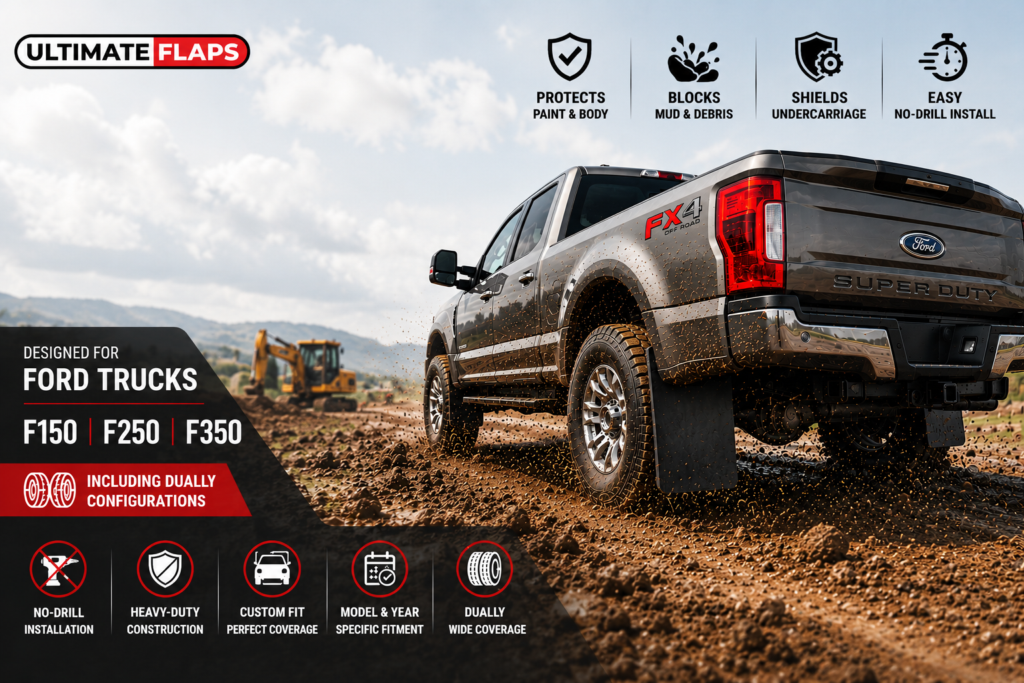
Ford trucks face constant exposure to rocks, gravel, mud, and road debris during everyday driving, towing, and highway travel. As tires rotate, they can throw debris toward lower body panels, wheel wells, and undercarriage components, gradually contributing to paint chipping, corrosion, and surface wear over time. Ford truck mud flaps help reduce this impact by deflecting debris away from vulnerable areas before damage occurs. For models such as Ford F150, Ford F250, and Ford F350, including dually configurations, proper mud flap installation plays a critical role in preserving surface integrity and durability. This post explains how mud flaps protect Ford trucks, when they are most needed, and how to choose the right fitment and material for different Ford models.
Common Problems Ford Truck Owners Face Without Mud Flaps
Following are the key problems Ford truck owners commonly experience without proper mud flap protection:
- Paint surface erosion from continuous debris impact: Road gravel and small stones repeatedly strike lower body panels, causing paint chipping and accelerated surface wear, particularly around wheel arches and rocker panels.
- Corrosion formation due to exposed metal surfaces: Moisture, salt, and road chemicals accumulate on unprotected areas, increasing the likelihood of rust development on exposed steel components.
- Undercarriage exposure to abrasive materials: Suspension components, brake lines, and fuel system elements are directly impacted by mud and debris, reducing long-term durability.
- High-speed rock projection on highways: At highway speeds, tires project debris at increased velocity, significantly increasing the risk of damage to adjacent vehicles, trailers, and lower body panels.
- Increased cleaning and maintenance frequency: Accumulation of mud and road contaminants requires repeated washing cycles, increasing overall maintenance time and upkeep costs.
Do Mud Flaps Actually Work on Ford Trucks
Mud flaps serve as a practical protective upgrade for Ford trucks by helping manage road debris, water spray, and surface wear encountered during daily driving, towing, and off-road use.
- Direct interception of tire-generated debris: Mud flaps serve as a practical protective upgrade for Ford trucks by helping manage road debris, water spray, and surface wear encountered during daily driving, towing, and off-road use.
- Reduction of paint surface impact exposure: By interrupting debris trajectory, mud flaps help minimize direct contact between road particles and painted surfaces.
- Improved control of water and slush spray in wet conditions: Water, slush, and road grime are redirected downward, reducing splash toward doors, side mirrors, and rear visibility areas.
- Long-term protection for lower body and undercarriage components: Reduced exposure to abrasive road materials can help limit premature wear on suspension parts, rocker panels, and structural components.
- Added protection for nearby vehicles and towing equipment: Mud flaps help reduce debris spray toward adjacent traffic, trailers, and towing accessories, supporting cleaner and safer driving conditions.
When Ford Trucks Need Mud Flaps Most
Mud flap requirement is determined by operating conditions, load behavior, and tire-generated debris intensity. Ford trucks operate across a wide spectrum of usage, and protection needs increase significantly under specific conditions.
- Towing and hauling applications (F150 / F250 / F350): Increased payload and trailer load cause greater tire deformation under torque. This increases the volume and distance of debris projection, making Ford truck mud flaps essential for consistent body and trailer protection during acceleration, braking, and highway cruising.
- Highway and long-distance driving: Sustained high-speed operation amplifies debris velocity. Even small gravel particles are ejected at higher force, increasing the risk of paint chipping, lower panel abrasion, and windshield or trailer impact damage from adjacent vehicles.
- Construction, agricultural, and job site usage: Loose aggregate materials such as gravel, clay, sand, and mud accumulate rapidly on tires. Without Ford f250 mud flaps or Ford F350 mud flaps, continuous debris discharge leads to accelerated underbody wear and frequent cleaning cycles.
- Dually configurations (F350 / F450): Wider rear axle spacing increases exposed tire surface area. In these configurations, Ford F350 dually mud flaps and mud flaps for Ford F450 dually are required to control lateral spray and prevent cross-lane debris projection.
- Heavy load conditions and fleet usage: Continuous operation under load increases tire flex and heat buildup, both of which intensify debris ejection force. Heavy duty mud flaps for Ford F350 dually and heavy-duty mud flaps for Ford F250 provide necessary structural resistance under sustained commercial use.
What Makes Ford Truck Mud Flaps Worth Buying
Here’s why you should invest in Ford truck mud flaps:
- No-drill installation systems for factory mounting points: No drill mud flaps for Ford trucks utilize existing OEM mounting locations, eliminating the need for structural modifications while preserving factory fit and finish.
- Heavy-duty material construction: Heavy duty mud flaps for Ford F250 and Ford F350 offered by leading brands like Ultimate Flaps are commonly manufactured using reinforced rubber or high-impact polyethylene compounds engineered to resist cracking, deformation, and road debris impact.
- Custom-fit engineering per vehicle model: Custom fit mud flaps for Ford F250 and Ford F350 are designed to match factory wheel arch dimensions, helping minimize exposed spray zones while improving debris and water control.
- Extended coverage for dual-wheel configurations: Ford dually mud flaps feature increased width and drop length to provide proper coverage for dual rear wheel setups and reduce side spray dispersion.
- Model and year-specific compatibility: Fitment requirements vary across generations, including applications such as Mud Flaps For 2019 Ford F250, Mud Flaps For 2022 Ford F250, and Mud Flaps For 2024 Ford F350.
How to Choose the Right Ford Truck Mud Flaps
Following are tips to choose the right ford truck mud flaps:
- Identify your Ford truck model first to ensure correct fitment: Select mud flaps specifically engineered for Ford F150, Ford F250, Ford F350, or Ford F450 models to ensure proper mounting alignment and wheel coverage.
- Match mud flaps to your exact vehicle year for accurate compatibility: Use model-year specific options such as mud flaps for 2019 Ford F250, mud flaps for 2022 Ford F250, or mud flaps for 2024 Ford F350 to prevent installation and clearance issues.
- Choose heavy-duty construction for demanding applications: Select heavy duty mud flaps for Ford F250 or heavy-duty mud flaps for Ford F350 dually applications when operating under towing, hauling, commercial, and off-road conditions.
- Select no-drill systems for faster installation and OEM fitment: Install no drill mud flaps for Ford trucks to simplify installation while maintaining OEM mounting integrity without additional drilling.
- Prioritize extended coverage for dually configurations: Use Ford F350 dually mud flaps or Ford F450 dually mud flaps to improve protection for wider rear tire setups and minimize lateral debris projection.
- Evaluate your driving environment before making a final selection: Choose reinforced mud flaps designed for highway driving, off-road terrain, towing applications, or commercial fleet use based on debris exposure and operating conditions.
Protect Your Ford Truck Before Road Debris Causes Costly Damage
Ultimate Flaps mud guards are engineered for Ford F150, F250, F350, and F450 platforms with precision fitment, heavy-duty construction, and no-drill installation. Designed for demanding real-world driving conditions, they help reduce paint damage, control road spray, and protect critical body and undercarriage components from long-term wear. Contact Ultimate Flaps today to choose the right mud flap system for your truck model and driving application.
Frequently Asked Questions
Mud flaps help reduce paint chipping, road debris impact, and lower body damage commonly experienced during daily driving, highway travel, and off-road use in Ford F150 trucks.
Yes. Ford F250 mud flaps help minimize debris projection generated by increased tire flex and road spray during towing and hauling operations.
Ford F350 dually mud flaps provide wider rear wheel coverage, helping reduce lateral debris spray, underbody exposure, and paint damage around dual rear tire configurations.
No drill mud flaps for Ford trucks are designed to utilize OEM mounting points, providing secure long-term fitment without requiring structural modifications to the vehicle.
Have an F-350 Dually with Aftermarket Wheels?
If you drive a Ford F-350 or F-450 dually with aftermarket wheels, mud flap fitment can require additional consideration. Wheel size, tire width, offset, and available clearance can all affect coverage and fit. Learn more about choosing the right mud flaps for modified Ford dually trucks in our detailed guide.
Read the Ford Dually Mud Flap Guide