

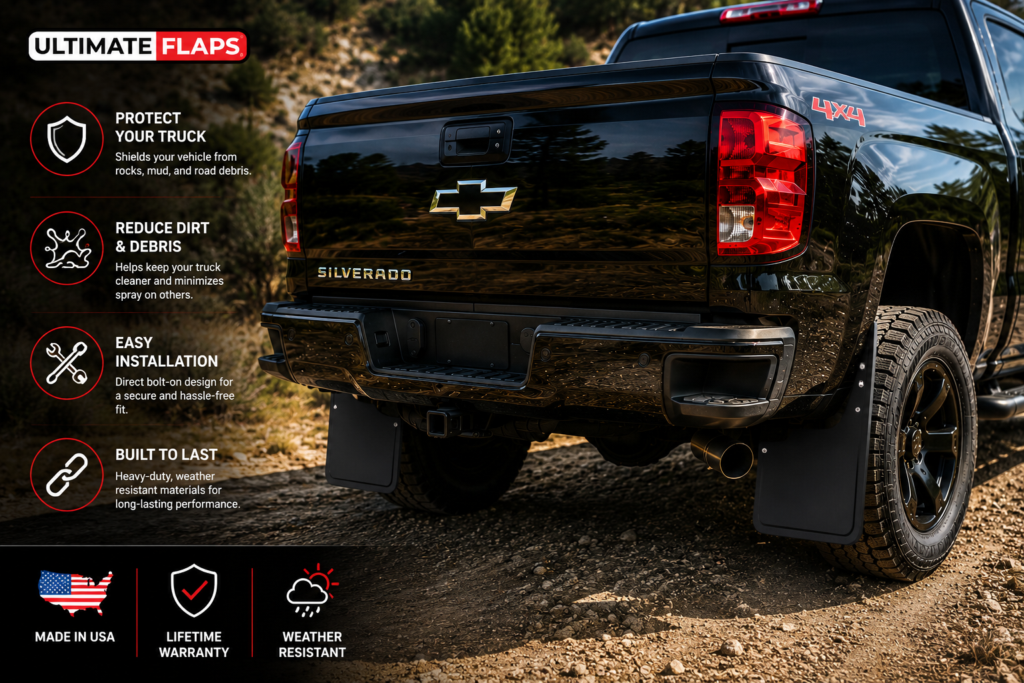
Mud flaps are one of those truck accessories that seem simple until fitment problems start showing up. A poorly fitted mud flap can rub against oversized tires, vibrate at highway speeds, drag during towing, or fail to provide proper road coverage. On heavy-duty Chevy trucks, lifted setups, and dually configurations, these problems become even more noticeable over time.
Chevy truck owners also face another challenge. Silverado 1500, 2500, and 3500 models differ in wheel clearance, suspension height, tire width, and rear wheel configuration. A flap that works perfectly on a Chevy 1500 may not fit correctly on a lifted Chevy 2500 or a Chevy 3500 dually. This is why choosing Chevy mud flaps requires more than simply selecting a universal option from a catalog.
This post explains why choosing the right Chevy mud flaps matters, the key factors to consider when selecting Chevy mud flaps for trucks, proper installation practices for long-term performance, and the most common Chevy mud flap fitment problems truck owners should avoid across Silverado 1500, 2500, 3500, lifted, towing, and dually truck setups.
Why Choosing the Right Chevy Mud Flaps Matters
Chevy mud flaps serve a practical purpose beyond appearance. Properly fitted mud flaps help in the following ways:
- Protecting Trucks from Road Debris and Stone Impact: Truck tires throw debris with considerable force, especially on highways, construction zones, and gravel roads. Without proper coverage, debris can:
- Chip paint along rocker panels
- Damage lower body surfaces
- Increase corrosion exposure
- Strike trailers or nearby vehicles
- Improving Coverage for Lifted Trucks and Oversized Tires: Lifted trucks and oversized tires expose a larger portion of the tire tread, allowing more debris to escape from underneath the vehicle. Standard mud flaps often become too short or too narrow after:
- Lift kit installations
- Larger tire upgrades
- Aftermarket wheel installations
- Reducing Spray and Debris During Towing and Highway Driving: Towing setups create additional debris-control challenges. Rear tires can throw gravel, water, and road debris directly toward:
- Campers
- Boats
- Utility trailers
- Equipment haulers
- Preventing Fitment and Clearance Issues Over Time: Improper mud flap sizing can create long-term problems such as:
- Tire rubbing
- Uneven flap wear
- Highway vibration
- Loose hardware
- Poor wheel coverage
Factors to Consider When Selecting Chevy Mud Flaps for Trucks
Selecting the right Chevy mud flaps involves more than choosing a design that looks good on the truck. Here are the key factors to consider before choosing Chevy truck mud flaps for your specific truck setup.
- Choosing Between Universal and Custom Fit Mud Flaps: Fitment style is one of the first factors to evaluate when selecting Chevy mud flaps for trucks. Universal mud flaps are manufactured to fit multiple vehicle models using adjustable mounting positions, while custom fit mud flaps are engineered around specific Chevy truck dimensions and factory mounting points. Universal options may appear convenient, but they often create alignment gaps, inconsistent coverage, and additional installation adjustments on Silverado 1500, 2500, and 3500 models. Custom fit splash guards generally provide cleaner installation, improved mounting stability, and better wheel-well alignment.
- Considering Mud Flap Flexibility and Stability: Mud flap flexibility directly affects how the flaps behave during highway driving, towing, and rough-road conditions. Flexible rubber mud flaps bend easily and adapt well to uneven terrain, but they may also curl, flutter, or lose shape over time. Rigid polyethylene Chevy mud guards maintain their structure more consistently under airflow pressure and debris impact. This improves stability, especially during long-distance towing and highway driving.
- Evaluating Mud Flap Material Quality: Material quality is another major factor when choosing Chevy pickup mud flaps. Lower-grade rubber and plastic materials often crack, fade, warp, or weaken after prolonged exposure to road debris, moisture, UV rays, and temperature changes. Heavy-duty polyethylene offers stronger resistance against impact damage, moisture absorption, road salt, and weather exposure. This makes it a reliable option for Chevy mud flaps for trucks used in demanding driving environments.
- Checking Tire Size and Wheel Coverage Requirements: Tire size and wheel setup significantly affect how well Chevy splash guards perform. Trucks equipped with oversized tires or aftermarket wheels often expose a larger tire footprint beyond the factory body lines. Standard-width mud flaps may fail to provide complete protection in these situations. Proper wheel coverage helps reduce debris spread, protects lower body panels, and improves trailer protection during towing.
- Evaluating Mounting Strength and Hardware Quality: Mounting stability directly affects long-term mud flap performance. Weak brackets or lower-grade hardware may loosen over time due to vibration, debris impact, towing stress, and highway airflow pressure. High-quality Chevy mud guards should use corrosion-resistant mounting systems capable of handling heavy-duty driving conditions. Stainless steel brackets, fasteners, and weighted trim plates help improve durability while reducing rust and corrosion exposure.
- Considering No-Drill Installation Compatibility: Installation compatibility is another important factor for Chevy truck owners. Many drivers prefer custom fit splash guards that use factory mounting points without requiring drilling into the truck body. No-drill systems simplify installation, help preserve factory paint, and reduce the risk of corrosion around exposed metal surfaces. Proper no-drill systems also improve fitment consistency because they align directly with factory attachment locations.
- Considering Long-Term Maintenance and Durability: Long-term durability should also be considered before purchasing Chevy mud flaps. Mud flaps remain exposed to gravel, snow, mud, road salt, moisture, and continuous debris impact throughout daily use. Durable Chevy mud flaps for trucks built with heavy-duty materials and corrosion-resistant hardware generally require less maintenance and maintain their appearance longer. This becomes especially valuable for towing setups, work trucks, and Chevy dually mud flaps exposed to demanding road conditions.
How to Install Chevy Mud Flaps Properly
Proper installation helps Chevy mud flaps perform correctly and prevent long-term fitment issues. Here are the key installation steps to follow.
- Verify Fitment Before Installation: Before installation, confirm the truck model, tire size, suspension height, wheel offset, and fender flare setup. Proper fitment verification helps prevent clearance issues, rubbing problems, and incorrect alignment after installation.
- Position the Mud Flaps Correctly: The mud flaps should sit evenly behind the tires while maintaining proper ground clearance. Correct positioning improves debris coverage, reduces vibration, and prevents tire contact during steering or suspension movement.
- Secure the Mounting Hardware Properly: Tighten all mounting hardware evenly to improve stability during highway driving and towing. Stainless steel brackets and corrosion-resistant fasteners help reduce loosening, vibration, rust formation, and long-term mounting wear.
- Check Alignment and Tire Clearance: After installation, inspect steering clearance, suspension movement, flap alignment, and spacing from the ground. This final inspection helps identify rubbing, uneven positioning, or wheel clearance issues before regular driving begins.
Common Chevy Mud Flap Fitment Problems and How to Avoid Them
Even properly sized Chevy mud flaps can develop fitment problems if installation, wheel clearance, or truck configuration is overlooked. Here are some of the most common issues truck owners face and how to avoid them.
- Tire Rubbing During Steering or Suspension Movement: Mud flaps that sit too close to oversized tires may rub during sharp turns or suspension compression. This problem commonly affects lifted trucks and aftermarket wheel setups. Proper spacing and correct flap sizing help prevent tire contact and uneven wear.
- Excessive Highway Vibration and Flap Flutter: Lightweight or poorly mounted Chevy mud guards often move excessively at highway speeds. Continuous flap vibration can loosen mounting hardware over time. Rigid mud flaps with reinforced brackets and weighted trim plates generally provide better highway stability and reduced movement.
- Insufficient Wheel Coverage on Oversized Tires: Oversized tires extend beyond factory wheel wells, exposing more of the tire tread. Standard Chevy splash guards may fail to provide complete debris protection in these setups. Wider custom fit mud flaps help improve tire-path coverage and debris control.
- Uneven Mud Flap Alignment After Installation: Incorrect mounting positions can leave mud flaps sitting unevenly behind the tires. Poor alignment affects both appearance and debris coverage. Using factory mounting locations and verifying spacing during installation helps maintain proper alignment on both sides.
- Loose Mounting Hardware Over Time: Road vibration, towing stress, and debris impact can gradually loosen lower-quality hardware. Loose mounting systems often create flap movement and mounting fatigue. Stainless steel brackets and corrosion-resistant fasteners help improve long-term mounting stability.
- Ground Clearance Problems on Lifted Trucks: Mud flaps that hang too low may drag on uneven roads, ramps, or off-road terrain. This issue becomes more noticeable on lifted Chevy trucks with larger tires. Proper flap height selection helps maintain ground clearance without reducing tire coverage.
- Inadequate Coverage on Chevy Dually Trucks: Standard mud flaps often fail to cover the wider rear tire footprint on dually trucks. Chevy 3500 dually mud flaps and custom dually mud flaps are specifically designed to improve debris protection across dual rear wheel setups and towing applications.
Get Heavy-Duty Protection with Ultimate Flaps Chevy Mud Flaps
The right Chevy mud flaps improve more than appearance. Properly fitted mud flaps help protect the truck body, improve towing safety, reduce debris spread, and hold up better under demanding driving conditions.
Whether you need mud flaps for Chevy 2500 trucks, Chevy 3500 dually mud flaps, or custom dually mud flaps for towing applications, Ultimate Flaps provides heavy-duty protection with clean fitment and lifetime-backed performance. Explore the complete lineup today and find Chevy mud flaps built to properly match your truck setup.
Frequently Asked Questions
Chevy 3500 dually mud flaps should provide extended rear coverage for both rear tires. Custom dually mud flaps generally offer better fitment and towing protection.
Heavy-duty polyethylene combined with stainless steel hardware generally provides stronger resistance for dually splash guards against cracking, curling, corrosion, and road impact.
Ultimate Flaps uses nearly indestructible polyethylene, 304 stainless steel weights, welded stainless hardware, powder-coated trim plate options, and lifetime-warranted construction on dually mud guards for improved durability and highway stability.