

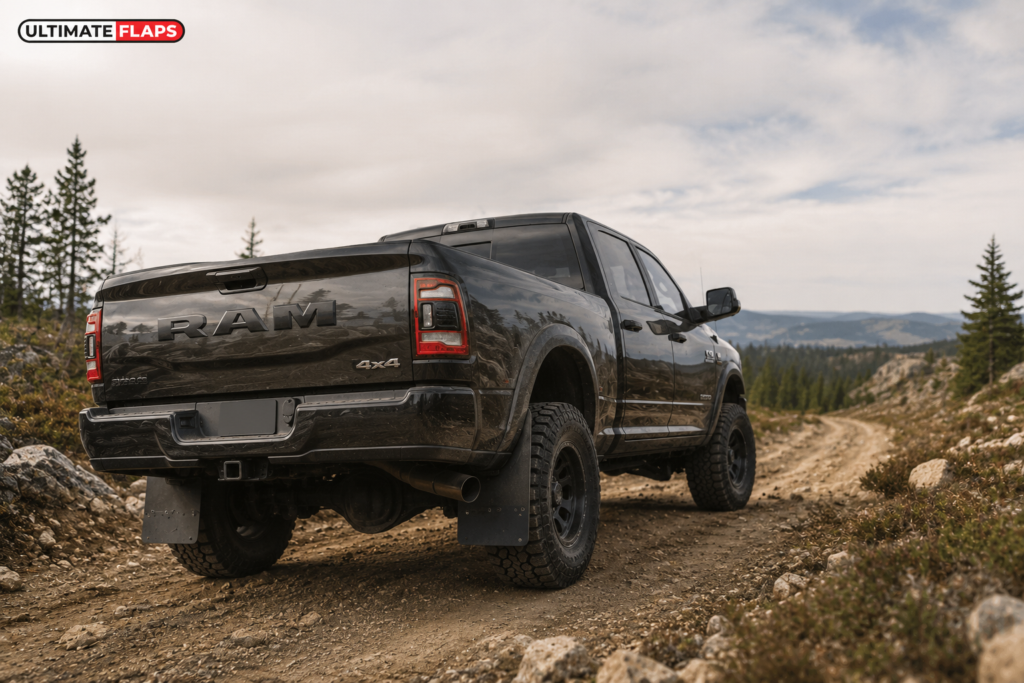
Dodge Ram trucks are commonly used for towing, hauling, jobsite travel, and other demanding applications. These operating conditions can expose the vehicle to mud, gravel, road debris, and water spray generated by the tires. If you drive a Ram 2500 or Ram 3500, you may encounter these conditions on highways, unpaved roads, and construction sites. Towing can also increase the amount of spray and debris directed toward the truck and trailer, making proper tire coverage an important consideration.
Many owners search for Dodge Ram 2500 mud flaps or Dodge Ram 3500 mud flaps to help protect their vehicles. No-drill mud flaps have gained popularity in recent years. However, fitment, coverage, and installation requirements can vary depending on the truck’s configuration and intended use. This post explores the benefits of no-drill mud flaps, key fitment considerations for Ram 2500 and Ram 3500 trucks, differences between single-rear-wheel and dually models, installation considerations, and more.
What Are No-Drill Mud Flaps and Why They Matter
No-drill mud flaps are designed to attach using existing mounting locations or hardware rather than requiring new holes in the vehicle body. Installation methods vary by product and vehicle application, but the goal is to avoid permanent modifications to the truck.
- No Additional Drilling: Many no-drill mud flap systems utilize existing mounting locations, eliminating the need to create new holes in body panels or wheel wells.
- Preserves Factory Components: By avoiding additional drilling, no-drill installations help maintain the vehicle’s original mounting surfaces and finish.
- Vehicle-Specific Fitment Options: Many no-drill mud flaps are designed for specific Ram truck model years and configurations, helping support proper fitment and installation.
- Removable Installation: Mud flaps installed using existing hardware can often be removed or replaced without modifying the original mounting locations.
Common Fitment Considerations for Standard and Universal Mud Flaps
Standard and universal mud flaps can be suitable for certain applications, but fitment and installation requirements may vary depending on the truck’s configuration. Ram 2500 and Ram 3500 models often require careful consideration of coverage, clearance, and mounting compatibility.
- Vehicle-Specific Fitment: Universal mud flaps are designed to fit multiple vehicle types and may not align precisely with every Ram truck wheel well configuration.
- Coverage Requirements: The amount of tire coverage provided can vary depending on mud flap size, tire dimensions, and vehicle setup.
- Lifted and Modified Trucks: Lift kits, larger tires, aftermarket wheels, and dually configurations can influence mud flap fitment and clearance requirements.
- Mounting Methods: Installation requirements vary by product. Some mud flaps utilize existing mounting locations, while others may require drilling, brackets, or additional hardware.
- Hardware Compatibility: Fasteners, clips, and mounting components should be compatible with the vehicle and installed according to the manufacturer’s instructions to support proper attachment.
Why No-Drill Mud Flaps Are Ideal for Ram 2500 & 3500 Trucks
When evaluating Dodge Ram 2500 mud flaps or Dodge Ram 3500 mud flaps, installation requirements are often an important consideration alongside fitment and coverage. Ram 2500 and Ram 3500 trucks are commonly used for towing, hauling, and worksite travel, making vehicle-specific fitment and secure attachment important factors when selecting mud flaps.
- Uses Existing Mounting Locations: Many no-drill mud flap systems are designed to utilize existing factory mounting points, reducing the need for additional holes in body panels or wheel wells.
- Supports Vehicle-Specific Fitment: Many mud flaps for Dodge Ram 2500 and Ram 3500 trucks are designed for specific model years and configurations, helping support proper alignment and installation.
- Provides Tire Coverage: Properly fitted Dodge Ram mud flaps can help reduce the amount of mud, gravel, water spray, and road debris projected by the tires during normal driving conditions.
- Can Be Removed for Service or Replacement: Mud flaps installed using existing hardware can often be removed or replaced without creating additional mounting holes in the vehicle.
- Available for Single-Rear-Wheel and Dually Models: No-drill options are available for a variety of truck configurations, including Dodge Ram 3500 dually mud flaps designed for dual-rear-wheel applications.
Ram 2500 vs Ram 3500: Mud Flap Fitment Considerations
Ram HD trucks may appear similar, but mud flap fitment requirements can vary based on wheel configuration, vehicle width, tire coverage needs and intended use. These differences are particularly important when comparing single-rear-wheel (SRW) and dual-rear-wheel (DRW) models.
Ram HD trucks may appear similar, but mud flap fitment requirements can vary based on wheel configuration, vehicle width, tire coverage needs and intended use. These differences are particularly important when comparing single-rear-wheel (SRW) and dual-rear-wheel (DRW) models.
| Feature | Ram 2500 | Ram 3500 SRW (Single Rear Wheel) | Ram 3500 DRW (Dually) |
| Rear Wheel Configuration | Single rear wheel | Single rear wheel | Dual rear wheels |
| Typical Use | Towing, hauling, daily work applications | Heavy towing, hauling, commercial applications | High-capacity towing and hauling applications |
| Vehicle Width | Standard | Standard | Wider rear track due to dual rear wheels |
| Tire Coverage Requirements | Varies by tire size and configuration | Varies by tire size and configuration | May require wider mud flap coverage due to the dual-wheel setup |
| Fitment Considerations | Model year, tire size, wheel offset, and accessories | Model year, tire size, wheel offset, and accessories | Model year, tire size, wheel offset, dual-wheel configuration, and accessories |
- Ram 2500 Mud Flap Considerations: Dodge Ram 2500 mud flaps are typically designed around single-rear-wheel configurations. Tire size, wheel offset, lift kits, and aftermarket accessories can all influence fitment and clearance requirements.
- Ram 3500 Mud Flap Considerations: Dodge Ram 3500 mud flaps are available for both single-rear-wheel and dual-rear-wheel trucks. Because dually models have a wider rear wheel configuration, Dodge Ram 3500 dually mud flaps are often designed with dimensions and coverage requirements specific to dual-wheel applications.
- Model-Year Compatibility: When selecting products such as 2022 Dodge Ram 2500 mud flaps or 2024 Ram 3500 dually mud flaps, it is important to verify compatibility with the truck’s model year, wheel configuration, and any aftermarket modifications.
Bottom Line: Mud flap fitment requirements can differ between Ram 2500, Ram 3500 SRW, and Ram 3500 dually trucks. Choosing a mud flap designed for the vehicle’s specific model year and configuration can help support proper fitment and coverage.
Fitment Considerations for Dodge Ram 1500 Models
While this guide focuses on Ram 2500 and Ram 3500 trucks, Ram 1500 owners may encounter similar fitment considerations when selecting mud flaps.
- Fender Flare Compatibility: Dodge Ram 1500 mud flaps with fender flares should be selected based on the specific flare configuration to help ensure proper fitment and coverage.
- Model-Year Differences: Products such as mud flaps for 2017 Dodge Ram 1500 with fender flares should be verified for compatibility with the vehicle’s model year and trim configuration.
- Tire and Suspension Modifications: Larger tires, wheel offset changes, and lift kits can influence clearance and fitment requirements for Dodge Ram 1500 mud guards and splash guards.
Installation Guide: No-Drill Mud Flaps for Dodge Ram Trucks
One of the biggest advantages of no-drill mud flaps is their straightforward installation process. They use existing factory mounting points, which eliminates the need to modify the truck body or drill into painted surfaces.
- Locate the Factory Mounting Points: Begin by identifying the mounting locations specified in the manufacturer’s instructions. Many Ram 2500 and Ram 3500 trucks include existing attachment points that can be used for mud flap installation.
- Position the Mud Flap and Bracket: Align the mud flap and any supplied brackets with the designated mounting locations. Before tightening the hardware, verify that the mud flap is positioned correctly behind the tire and follows the installation instructions provided with the product.
- Install the Fasteners: Attach the supplied bolts, clips, or brackets according to the manufacturer’s instructions. Start by hand-tightening the hardware to allow for minor adjustments if needed. Hand-tightening is important as it helps prevent misalignment and ensures a cleaner final fit.
- Check Alignment and Clearance: Before fully securing the assembly, inspect the mud flap from multiple angles and confirm that:
- The mud flap is properly aligned.
- Adequate tire clearance is maintained.
- The mud flap does not contact suspension, steering, or wheel components.
- The installed position provides the intended tire coverage.
- Tighten the Hardware: Once alignment and clearance have been verified, tighten all hardware according to the manufacturer’s specifications. After installation, inspect the mounting system to confirm that all fasteners are secure.
For most truck owners and technicians, installation can be completed with basic hand tools in a relatively short amount of time, making no-drill mud flaps one of the easiest protection upgrades for a Ram truck.
Protect Your Ram with Mud Flaps Built for the Right Fit
Selecting the right mud flaps involves more than choosing a size or style. Fitment, coverage, installation requirements, and vehicle configuration all play an important role in long-term performance. Whether you’re evaluating Dodge Ram 2500 mud flaps, Dodge Ram 3500 mud flaps, or Dodge Ram 3500 dually mud flaps, choosing a solution designed for your truck’s model and wheel configuration can help support proper fitment and coverage.
Ultimate Flaps offers vehicle-specific mud flaps for Ram 2500 and Ram 3500 trucks, including dually applications. Contact our team today to discuss your truck’s configuration and find the right mud flap solution for your needs.
Frequently Asked Questions
Not always; fitment can vary based on model year, wheel configuration, and truck-specific dimensions.
Dually trucks typically require mud flaps designed to accommodate the wider dual-rear-wheel configuration.
Many no-drill mud flap systems utilize existing mounting locations and do not require additional holes in the vehicle body.
Yes, suspension modifications, tire size, and wheel offset changes can influence mud flap clearance and coverage requirements.
Verify compatibility based on your truck’s model year, wheel configuration, tire setup, and any aftermarket accessories.