

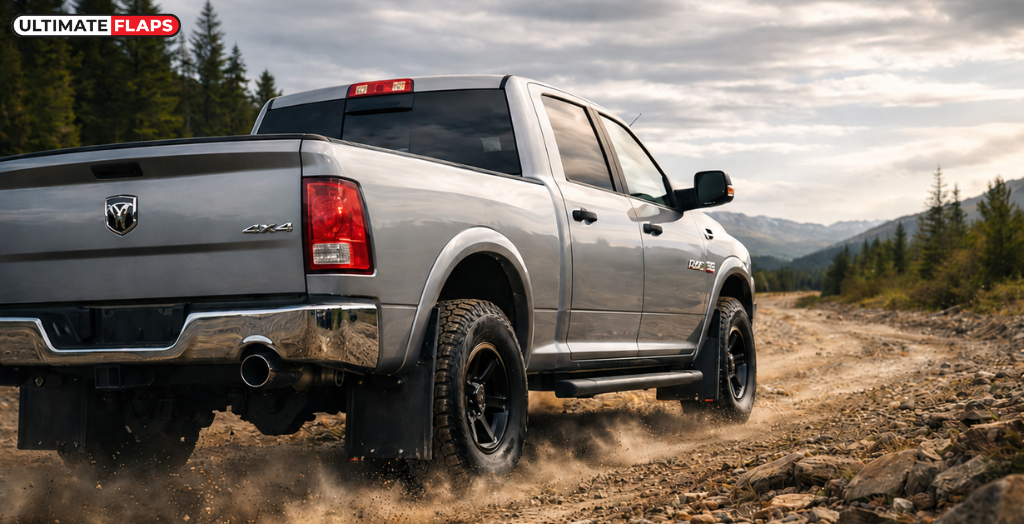
Mud flaps are one of those truck accessories that seem straightforward until you try to buy the right set. For Dodge Ram owners, getting the fitment wrong is more common than most people expect. Trucks in the same model year can have different fender configurations, tire sizes, and wheel arch heights depending on the trim and cab setup. A flap that fits a standard Ram 1500 will not necessarily work on a lifted Ram 2500 or a dually Ram 3500. Beyond fit, improperly sized mud flaps can rub against tires, fail to cover the tire path effectively, or look out of place on the truck. Getting the right Dodge Ram mud flaps comes down to knowing your specific truck’s configuration before you buy. This post discusses Dodge Ram mud flap fitment, differences between Ram 1500, 2500, and 3500, what size mud flaps you need, what works best for different Ram trucks, common mistakes to avoid, and key factors to consider before purchasing.
Understanding Dodge Ram Mud Flap Fitment
Getting the right fit is not just about appearance. It affects how well your truck stays protected on rough roads and highways. Dodge Ram mud flaps need to align with factory mounting points and follow the contour of the wheel well. A poor fit can leave gaps, causing debris to escape and hit the body panels. Some setups also interact with wiring and mounting brackets near the wheel area, so proper alignment becomes important for long term durability.
There is also a difference in how each truck handles load, suspension movement, and clearance. This is where a well-planned assembly approach matters. Many professional setups rely on structured component integration, like how a wire harness assembly is organized for consistent routing and secure connections. The idea is simple; everything should fit cleanly without forcing parts into place. For Ram trucks, this means choosing mud flaps that match the vehicle’s build instead of adjusting the truck to fit the flaps.
Ram 1500 vs. 2500 vs. 3500: How the Trucks Differ in Mud Flap Sizing
Feature | Ram 1500 | Ram 2500 | Ram 3500 |
Wheel Well Coverage | Designed for standard driving setups, offers balanced coverage without excess overhang, ensuring compatibility with stock tires and moderate clearance without interference issues. | Requires broader coverage due to heavier suspension travel, ensuring better debris control for work conditions and uneven terrain while maintaining proper alignment during load shifts. | Needs extended coverage, especially for dual rear wheels, ensuring both inner and outer tires remain protected from debris spread across wider rear axle setups. |
Tire Compatibility | Works well with factory tires and mild upgrades but may need adjustments if wider tires or aftermarket wheels are installed for improved stance or off-road use. | Supports larger tire setups commonly used in heavy-duty applications, providing better adaptability for upgraded wheels while maintaining effective splash protection during demanding driving conditions. | Built for wide rear tire configurations, especially in dually setups, requiring specialized mud flap designs to ensure full coverage across extended axle width. |
Ground Clearance Fit | Suitable for standard ride height, ensuring proper spacing between flap and road surface without dragging during normal driving or mild terrain variations. | Requires slightly increased clearance due to suspension flex, preventing contact with uneven surfaces while maintaining consistent protection across different load conditions. | Needs careful clearance setup, especially for towing, to prevent interference during load compression and ensure stability across varying road and terrain conditions. |
Mounting Alignment | Typically aligns with factory mounting points, making installation straightforward for most users without requiring major adjustments or additional drilling in standard configurations. | May require reinforced mounting due to heavier use, ensuring stability and preventing movement during off-road driving or when carrying significant loads over extended distances. | Often involves specialized mounting systems, especially for dually models, ensuring secure attachment across wider rear sections without compromising structural stability or ease of maintenance. |
Usage Suitability | Ideal for daily driving and light off-road use, providing reliable protection without adding unnecessary bulk or affecting the truck’s overall driving dynamics. | Suited for heavy-duty work and mixed terrain, offering stronger protection against debris, gravel, and mud encountered during demanding job site or off-road conditions. | Best for towing and commercial use, especially in dually configurations, where extended coverage is needed to protect trailers and surrounding vehicles from debris impact. |
What Size Mud Flaps Do You Need
Choosing the right size is the step most Ram owners skip, and it is exactly where fitment problems start. Size is not just about width. Height, mounting position, and tire clearance all factors into whether a mud flap will perform correctly on your specific truck.
- Match Flap Width to Tire Width: The flap should be wide enough to cover the full tire tread path. Wider tires on lifted trucks or dually setups require wider flaps. Undersized flaps leave the tire path partially unprotected.
- Check Flap Height Against Ground Clearance: A flap that sits too low will drag on the ground, especially on lifted trucks or off-road setups. Measure from the mounting point to the ground and subtract appropriate clearance before selecting flap height.
- Account for Fender Flares: If your Ram has fender flares, whether factory or aftermarket, the flap needs to sit flush with or just inside the flare edge. Standard flap sizing without accounting for flares often results in visible gaps or misaligned coverage.
- Front and Rear Sizing Are Different: Front mud flaps on Ram trucks are typically narrower than rear flaps. The rear tire footprint, particularly on HD and dually models, demands wider and sometimes taller rear flap coverage than the front axle requires.
Choosing the Right Mud Flaps for Your Specific Ram Setup
Not every Ram truck has the same needs. The right flap for a daily driver Ram 1500 is a different product from what a work-spec Ram 3500 dually requires. Here is a practical guide by truck type.
- Ram 1500 Standard Setup (No Lift, No Flares): Factory-fit front and rear flaps sized to the standard tire width work well here. Models covering 2017 through 2024 Ram 1500 mud flap fitment are available in year-specific options for clean, no-drill installation.
- Ram 1500 with Fender Flares: This is a common fitment mistake. Standard flaps will not sit correctly behind fender flares. Dodge Ram 1500 mud flaps with fender flares require flaps sized to align with the flare edge. Mud flaps for 2017 Dodge Ram 1500 with fender flares, for example, need to be verified for flare compatibility specifically.
- Ram 1500 Lifted: A lifted 1500 with larger tires needs wider flaps and shorter overall height to prevent ground drag. Confirm tire width and ride height before selecting a flap size for any lifted application.
- Ram 2500 (SRW): Mud flaps for Dodge Ram 2500 need to cover a wider rear tire path than 1500 flaps. Year-specific fitment for 2019, 2022, and 2024 Dodge Ram 2500 mud flaps differs. Always cross-reference your trim and fender flare configuration before ordering.
- Ram 3500 Dually: Dodge Ram 3500 dually mud flaps need to cover the full dual rear tire footprint. Standard width flaps will not provide adequate protection. Dodge Ram 3500 mud guards for dually applications are specifically wider at the rear to address this requirement.
Common Mud Flap Mistakes to Avoid on Dodge Ram Trucks
A surprising number of Ram owners end up returning mud flaps because of avoidable fitment errors. Most of these mistakes come down to assuming compatibility without verifying the details first.
- Ordering by Model Name Alone: Ram 1500, 2500, and 3500 are broad categories. Trim level, cab configuration, bed length, and fender flare presence all affect fitment. Model name alone is not enough information to guarantee a correct fit.
- Ignoring Year-Specific Differences: Body style updates between model years change fender mounting points and fender geometry. A flap listed for a 2017 Dodge Ram 1500 mud guards application may not mount correctly on a 2020 or 2022 model without verification.
- Choosing Universal Flaps for HD Trucks: Universal mud flaps are not sized for Ram 2500 or 3500 applications, particularly dually rear axle setups. Dodge Ram dually mud flaps require rear flap widths that no universal option can reliably provide.
- Forgetting to Check Tire Clearance on Lifted Trucks: Flaps that are too tall will contact the tire during suspension travel or steering lock. Always measure from the mounting hole to the lowest point of the tire arc before selecting flap height for lifted Ram trucks.
Get the Right Fit Before You Buy
Mud flap fitment on Dodge Ram trucks is specific enough that taking a few minutes to verify your truck’s details before purchasing makes a real difference in the result. The wrong size or a universal fit option on an HD or dually truck will underperform from day one. At Ultimate Flaps, we offer custom-fit Dodge Ram mud flaps for Ram 1500, 2500, and 3500 trucks, including dually configurations and fender flare setups, built to exact fitment specs. For more information or queries, explore our website today and get the mud flaps your Ram truck needs.
Frequently Asked Questions
Properly installed mud flaps have minimal impact on fuel efficiency, but oversized or poorly fitted options can create drag, slightly affecting highway performance over long distances.
Yes, but you need to consider wheel offset and tire width, ensuring the mud flaps extend far enough to cover the tire’s outer edge effectively.
Yes, they help control debris spread from dual rear wheels, reducing the risk of damage to trailers and improving overall road safety during towing.
In most cases, lifted trucks need longer flaps, so reusing stock ones may reduce effectiveness and leave parts of the tire exposed.
Having Fitment Problems With Ram 2500 or 3500 Mud Flaps?
Ram 2500 and 3500 trucks can have different mud flap fitment requirements depending on the model year, tire and wheel setup, dually configuration, and available mounting space. If you are experiencing clearance, alignment, mounting, or coverage issues, our detailed guide explains common Ram mud flap fitment problems and how to avoid them.