

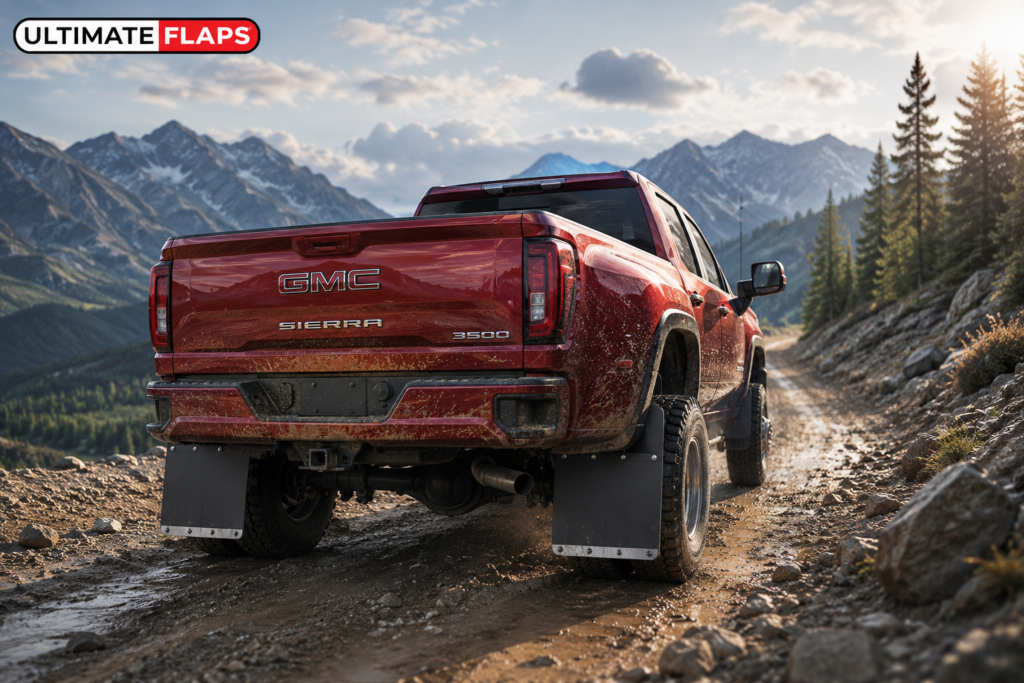
GMC Sierra 2500 and GMC Sierra 3500 trucks are built for demanding applications, including towing, hauling, worksite travel, and off-road driving. These operating conditions can expose the vehicle to mud, gravel, road debris, and water spray generated by the tires. Whether you’re driving on highways, construction sites, or unpaved roads, properly fitted GMC truck mud flaps can help provide additional protection for your truck and surrounding vehicles.
Many owners search for GMC 2500 mud flaps or GMC 3500 dually mud flaps to improve coverage and accommodate their truck’s specific configuration. However, fitment, installation, and coverage requirements can vary depending on the model year, wheel configuration, suspension modifications, and intended use. This guide explores the differences between GMC Sierra 2500 and 3500 mud flaps, key fitment considerations, no-drill and traditional installation methods, and what to look for when selecting heavy-duty mud flaps for your truck.
Why Heavy-Duty GMC Trucks Need Mud Flaps
GMC Sierra 2500 and 3500 trucks encounter a wide range of road and jobsite conditions. Choosing the right mud flaps helps ensure coverage that matches the truck’s intended use and configuration.
- Help Reduce Mud and Road Debris: As the tires rotate, they can project mud, gravel, stones, and other road debris toward the truck body and surrounding vehicles. Properly fitted mud flaps help reduce the amount of debris thrown by the tires during normal driving conditions.
- Support Paint and Body Protection: Mud flaps can help protect lower body panels, rocker panels, and rear fenders from debris that may contribute to paint chips and surface wear over time, particularly on gravel roads and construction sites.
- Improve Coverage While Towing and Hauling: Towing trailers or carrying heavy loads can increase the amount of water spray and road debris generated by the rear tires. GMC mud guards provide additional tire coverage to help manage these conditions.
- Suitable for Worksite and Off-Road Driving: GMC Sierra HD trucks frequently operate on unpaved roads, job sites, and other challenging terrain where loose gravel, mud, and stones are common. Heavy-duty mud flaps can provide added coverage in these environments.
- Support Compliance with Vehicle Configuration: Depending on the truck’s tire size, wheel configuration, or aftermarket modifications, properly fitted mud flaps can help provide tire coverage that aligns with the vehicle’s intended application and fitment requirements.
GMC Sierra 2500 vs. GMC Sierra 3500: Mud Flap Fitment Considerations
Although the GMC Sierra 2500 and GMC Sierra 3500 share many design characteristics, mud flap fitment can vary depending on the model year, wheel configuration, vehicle dimensions, and intended use. These differences become particularly important when comparing single-rear-wheel (SRW) and dual-rear-wheel (DRW) models.
| Feature | GMC Sierra 2500 | GMC Sierra 3500 SRW | GMC Sierra 3500 DRW (Dually) |
|---|---|---|---|
| Rear Wheel Configuration | Single rear wheel | Single rear wheel | Dual rear wheels |
| Typical Applications | Towing, hauling, and everyday work | Heavy towing, hauling, and commercial applications | Heavy towing, hauling, and commercial applications |
| Vehicle Width | Standard | Standard | Wider rear track due to dual rear wheels |
| Coverage Considerations | Varies based on tire size and vehicle configuration | Varies based on tire size and vehicle configuration | May require wider mud flap coverage because of the dual-wheel configuration |
| Fitment Considerations | Model year, tire size, wheel offset, and accessories | Model year, tire size, wheel offset, and accessories | Model year, dual-wheel configuration, tire size, wheel offset, and accessories |
- GMC Sierra 2500 Mud Flap Considerations: GMC 2500 mud flaps are typically designed for single-rear-wheel configurations. When selecting mud flaps, verify compatibility with the truck’s model year, tire size, wheel offset, and any aftermarket accessories that could influence fitment.
- GMC Sierra 3500 Mud Flap Considerations: The GMC Sierra 3500 is available in both single-rear-wheel (SRW) and dual-rear-wheel (DRW) configurations. As dually models have a wider rear wheel configuration, they may require dually mud guards designed to provide coverage appropriate for the wider rear tire setup. GMC mud flaps should be selected based on the truck’s wheel configuration, model year, tire size, and any aftermarket modifications to help support proper fitment and coverage.
- Flatbed Truck Considerations: Some GMC Sierra chassis cab models are equipped with flatbed bodies, which can change rear body dimensions, mud flap mounting methods, and coverage requirements. GMC mud flaps for flatbed trucks should be selected based on the flatbed body, wheel configuration, and available mounting locations to help support proper installation and coverage.
Choosing the Right GMC Sierra Mud Flaps by Model Year
The GMC Sierra HD lineup has evolved across multiple generations, with changes to body styling, wheel well design, and mounting locations. Selecting GMC mud flaps designed for your truck’s model year can help support proper fitment and installation.
- 2nd Generation GMC Sierra HD (2007–2014): Second-generation Sierra HD trucks were offered in a variety of cab styles, bed lengths, and single- or dual-rear-wheel configurations. When selecting GMC 2500 mud flaps or GMC mud guards, verify compatibility with your truck’s body style, wheel configuration, and model year.
- 3rd Generation GMC Sierra HD (2015–2019): The third-generation Sierra HD introduced updated front-end styling while continuing to offer multiple cab, bed, and wheel configurations. If your truck is equipped with larger tires, aftermarket wheels, or fender flares, verify that the selected mud flaps are compatible with those modifications.
- 4th Generation GMC Sierra HD (2020+): The fourth-generation Sierra HD features a redesigned body, updated wheel openings, and additional trim-specific variations. Choosing custom fit mud flaps designed for your truck’s model year and configuration can help support proper alignment, coverage, and installation.
Common Fitment Considerations for GMC Sierra Mud Flaps
Several factors can influence mud flap compatibility beyond the truck’s model year. Evaluating these considerations before purchasing can help support proper fitment and installation.
- Lift Kits: Suspension lifts can change the relationship between the tire and wheel opening, affecting mud flap clearance.
- Oversized Tires: Larger tires may require additional clearance and can influence the amount of tire coverage needed.
- Wheel Offset: Wheels with a more aggressive offset can project debris farther from the vehicle, affecting coverage requirements.
- Dually Configurations: GMC Sierra 3500 dual-rear-wheel trucks typically require wider mud flaps than single-rear-wheel models.
- Flatbed Bodies: Flatbed truck mud flaps should be selected based on the flatbed body’s dimensions, mounting locations, and wheel configuration.
- Universal vs Custom Fit: Universal fit mud flaps may be suitable for some applications, while custom fit mud flaps are designed for specific model years and configurations.
No-Drill vs. Traditional Mud Flaps for GMC Sierra Trucks
Mud flap installation methods vary by product design and vehicle application. While some systems utilize existing mounting locations, others require drilling into body panels or wheel wells. Understanding these differences can help you choose an installation method that aligns with your truck’s configuration and maintenance preferences.
Comparing No-Drill and Traditional Installation
Regardless of the installation method, always verify compatibility with your truck’s model year, wheel configuration, and any aftermarket modifications. Following the manufacturer’s installation instructions helps support proper fitment and secure attachment.
| Feature | No-Drill Mud Flaps | Traditional Installation |
|---|---|---|
| Vehicle Modifications | Typically utilizes existing mounting locations | May require drilling or additional mounting hardware |
| Installation Method | Uses existing hardware or mounting locations, depending on the product | May require drilling, brackets, or additional hardware |
| Factory Finish | No additional holes are typically created in body panels | Installation may involve permanent modifications |
| Future Removal | Can often be removed using the original mounting locations | Removal depends on the installation method used |
| Vehicle Compatibility | Commonly available as vehicle-specific designs | Available in both vehicle-specific and universal designs |
| Typical Applications | Daily driving, towing, hauling, and work truck applications | Varies by product design and installation requirements |
Regardless of the installation method, always verify compatibility with your truck’s model year, wheel configuration, and any aftermarket modifications. Following the manufacturer’s installation instructions helps support proper fitment and secure attachment.
What Makes Heavy-Duty GMC Truck Mud Flaps Different from Standard Passenger Vehicle Mud Flaps
Heavy-duty trucks often operate in conditions that differ from those of passenger vehicles, including towing, hauling, jobsite travel, and off-road driving. As a result, heavy-duty mud flaps are commonly designed with features that accommodate larger tires, higher ground clearance, and truck-specific fitment requirements.
- Vehicle-Specific Fitment: Many heavy-duty GMC truck mud flaps are designed for specific model years, wheel configurations, and truck applications, helping support proper alignment and coverage.
- Larger Coverage Area: Heavy-duty GMC mud flaps are often designed to provide greater tire coverage than standard passenger vehicle mud flaps, particularly for trucks equipped with larger tires or dual rear wheels.
- Compatibility with Dually Trucks: GMC 3500 dually mud flaps are designed to accommodate the wider rear wheel configuration found on dual-rear-wheel trucks, helping provide coverage appropriate for the wider tire setup.
- Support for Flatbed Applications: Flatbed truck mud flaps are available for certain chassis cab and commercial truck configurations where body dimensions and mounting methods differ from standard pickup beds.
- Designed for Larger Tire and Wheel Configurations: Heavy-duty mud flaps are often designed to accommodate larger tires, wider wheel offsets, and truck-specific wheel configurations, helping provide coverage appropriate for heavy-duty applications.
Common Applications for Heavy-Duty GMC Mud Flaps
Heavy-duty GMC trucks are used across a wide range of applications, and mud flap requirements can vary depending on how the vehicle is configured and operated.
- Daily Driving and Highway Travel: Help manage water spray and road debris during everyday driving.
- Towing and Hauling: Additional rear tire coverage can be beneficial when towing trailers or hauling heavy loads.
- Construction and Job Sites: Loose gravel, mud, and uneven terrain may increase exposure to debris.
- Off-Road Recreation: Unpaved trails and rocky surfaces can create conditions where additional tire coverage is desirable.
- Commercial and Flatbed Applications: Trucks equipped with flatbed bodies or dual rear wheels often require application-specific mud flap configurations.
Find Mud Flaps Designed for Your GMC Sierra Configuration
Selecting the right mud flaps starts with choosing a product designed for your truck’s model year, wheel configuration, and intended application. Whether you need GMC 2500 mud flaps for a single-rear-wheel truck, GMC 3500 dually mud flaps for wider rear tire coverage, or GMC mud flaps for flatbed trucks, vehicle-specific fitment can help support proper installation and coverage.
Ultimate Flaps offers custom fit mud flaps engineered for a wide range of GMC Sierra HD configurations, including dually and flatbed applications. Contact our team today to find the right mud flap solution for your GMC truck.
Frequently Asked Questions
GMC 2500 and GMC 3500 mud flaps are not universally interchangeable, as fitment depends on the truck’s model year, wheel configuration, body style, and intended application.
Yes. Dually mud flaps are designed to provide coverage for trucks equipped with dual rear wheels and their wider rear tire configuration.
Many no-drill mud flap systems are designed to utilize existing factory mounting locations, although installation methods vary by manufacturer and product.
Custom fit mud flaps are designed for specific vehicle applications, while universal fit mud flaps are intended to fit multiple vehicles and may require additional adjustments.
Flatbed truck mud flaps are typically selected based on the flatbed body’s dimensions, wheel configuration, and available mounting locations to help support proper fitment.
Explore Mud Flap Guides for Other Truck Brands
Ram 2500/3500 Mud Flaps: Common Fitment Problems & How to Avoid Them
Learn about common mud flap fitment issues on Ram 2500 and 3500 trucks, including clearance, alignment, mounting, and coverage.
Read Ram GuideDodge Ram Mud Flaps Fitment Guide: 1500, 2500 & 3500
Explore mud flap fitment considerations for Ram 1500, 2500, and 3500 trucks across different configurations.
Read Ram Fitment Guide